|
What is LON-CAPA? Who is LON-CAPA? Documentation Installation Scholarship Developers Events |
|||||||||||||||||||||||
The LearningOnline Network with CAPA |
|||||||||||||||||||||||
| Home > What is LON-CAPA? > LON-CAPA for Faculty > Shared Content Repository | |||||||||||||||||||||||
Shared Content Repository
Writing teaching materials can be a lot of work. That's why it is important to be able to share such resources among courses, instructors, departments, and institutions. LON-CAPA enables just that. Each faculty author can decide at which level he or she is willing to share content with others. The table shows statistics for available shared content resources, as of Summer 2018. Multiple versions of the same resource are only counted once.
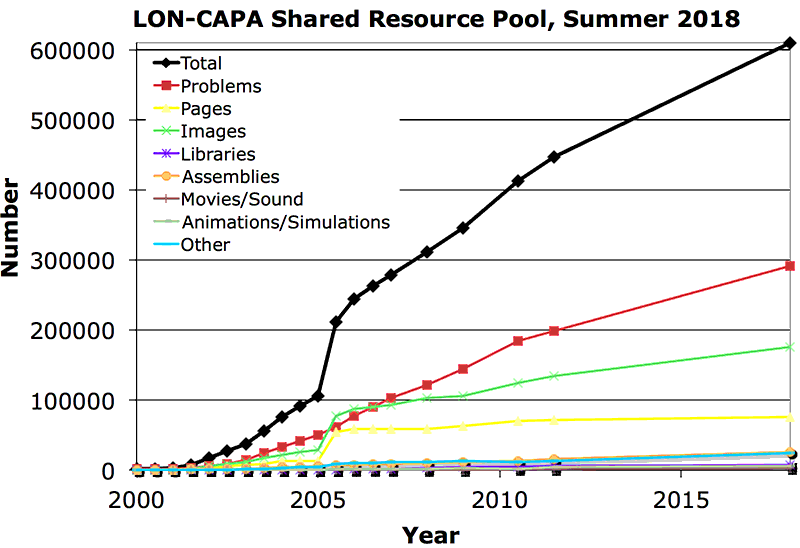
The graph shows the development of the LON-CAPA Shared Resource Pool over the years.
At the beginning of the project, we believed that monetary incentives would be needed to motivate faculty tp share their material, and a system for charging for the use of others' resources was included. In the meantime we found that faculty are far less interested in earning usage fees than feeling a sense of accomplishment when they see the usage counters clicking or receive positive feedback from their peers. Proposed payment and bartering schemes were also seen as too complicated, and it was decided that they might inhibit rather than foster the expansion of the network. It seems that sharing resources fits into the academic culture, just like research papers are shared. This conclusion might be subject area specific: most participating faculty are from the natural sciences, and most resources are intended for introductory courses. Faculty members might take pride in writing a high quality homework problem regarding angular momentum conservation, but hardly base their reputation on it, or are competing with peers teaching the same topic. Also, the physics taught in these courses is far from controversial, so that authors do not have to worry about scrutiny with regards to matters of opinion. In discussions with authors, the most important aspect appears to be good stewardship of the material: the project needs to guarantee that materials, some of them exam or grading-relevant homework problems, do not "leak" out of the pool; that is, students only have access to the material that faculty select for them. Particularly sensitive is the XML source code of the problems, because it allows for reverse-engineering of the randomization and determination of the correct solution for any variation of the problem.
|
|||||||||||||||||||||||
Contact Us: lon-capa@lon-capa.org Site maintained by Gerd Kortemeyer. |
|
||||||||||||||||||||||
| ©2013 Michigan State University Board of Trustees. | |||||||||||||||||||||||
 Faculty members have written most of these resources, sometimes in connection with externally funded projects, but mostly originally for use in their own courses. For example, through the MultiMedia Physics and contributions from other authors, complete algebra- and calculus-based physics courses are available as a free textbook replacement. For years, several otherwise rather traditional physics courses at Michigan State University have been taught without a traditional textbook. We found much willingness of faculty to make their materials available to the pool, and the vast majority of the material in the system is published "system-wide." From workshops and private conversations it is apparent that the few authors who wish to restrict their materials to their own institutions are often hesitate to submit their material to public scrutiny rather than a general unwillingness to share.